


Western markets exhibit negative learning curves while Asian markets show the opposite, forcing the question: Is the “cost curse” a fundamental property of nuclear physics, or merely a symptom of Western industrial atrophy?
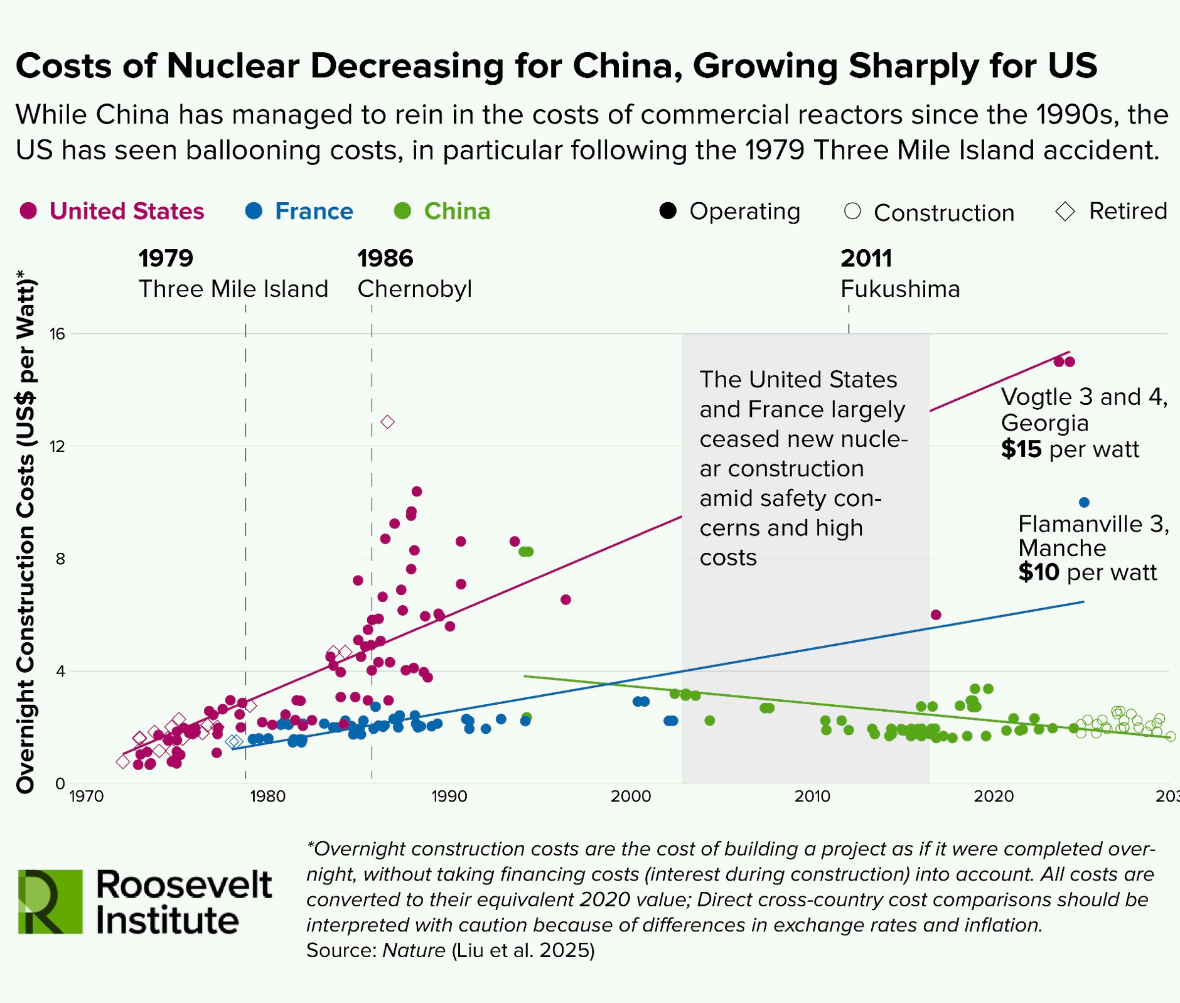
Intrinsic Evidence (The Western “Curse”): The US and UK exhibit “negative learning” where experience leads to higher costs—exemplified by Vogtle hitting ~$15,700/kW (3x initial estimates)—driven by a “regulatory ratchet” that has increased steel and concrete intensity per MW by over 30% since the 1970s.
Regional Evidence (The Asian “Counter-Proof”): South Korea and China demonstrate positive learning through strict standardization and continuous fleet deployment, delivering modern reactors for $2,500–$3,500/kW (approx. 1/5th the Western cost) and proving that industrial continuity can override technological complexity.
One explanation for this observational paradox is that “Forgetting Rates” (atrophy) can outpace “Learning Rates” when the construction cadence drops below a critical threshold.
If you build slowly you “pause” progress and actively lose ground to two forces that function as a tax on time: Knowledge Depreciation (“Forgetting”) and the Regulatory Ratchet.
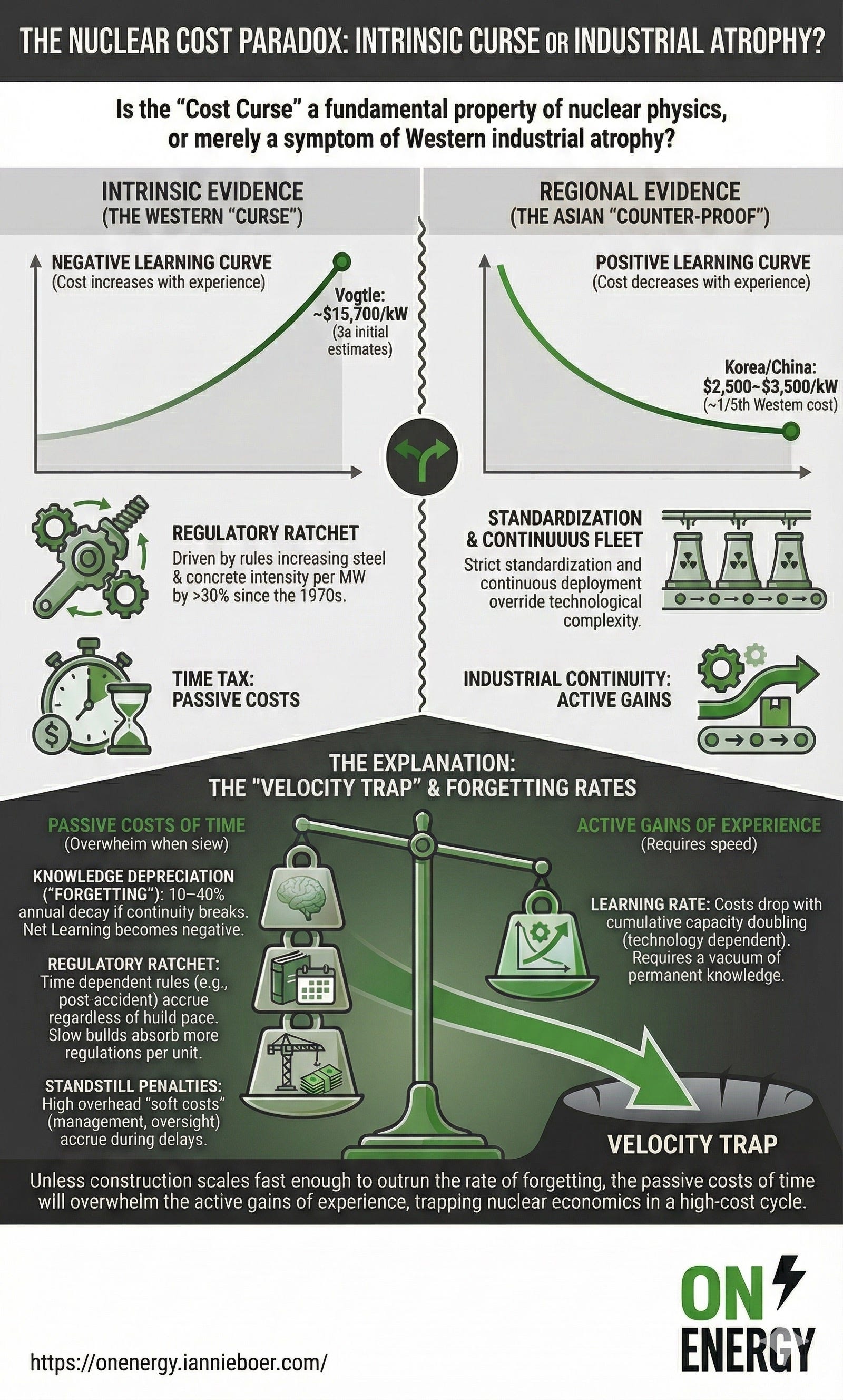
“Wright’s Law” assumes costs drop for every doubling of cumulative capacity (the pace of learning is technology dependent). However, this assumes a vacuum where knowledge is permanent. In reality, knowledge decays.
“Forgetting”: Research on “organizational forgetting” in complex engineering suggests a knowledge depreciation rate of 10–40% per year if continuity is broken. If you do not double your capacity fast enough to outrun the 10–40% annual decay, your “Net Learning” is negative.
Regulatory Ratchet: Regulation is a function of time, not just capacity. For nuclear, accidents (Three Mile Island, Chernobyl, Fukushima) have happened on a calendar timeline, not a construction timeline. Every year that passes brings new safety rules (the “Ratchet”). If you build one reactor every 10 years, that single reactor must absorb 10 years’ worth of new regulations.
Nuclear also suffers from “Standstill Penalties” due to their high overhead “soft costs” (project management, engineering oversight). Delays defer project progress while these cost continue to accrue.
In short, nuclear economics appear governed by a ‘velocity trap’: unless capacity additions progress fast enough to outrun the rate of forgetting, the passive costs of time will overwhelm the active gains of experience.