


AI is changing the foundation of white collar work. It changes how we make decisions, and how we interact with our tools and each other along the way. This is a map of the vectors of change I can see and the consequences that follow from each one. The point is to “name the thing”, or pillar, so we can better grapple with its consequences.
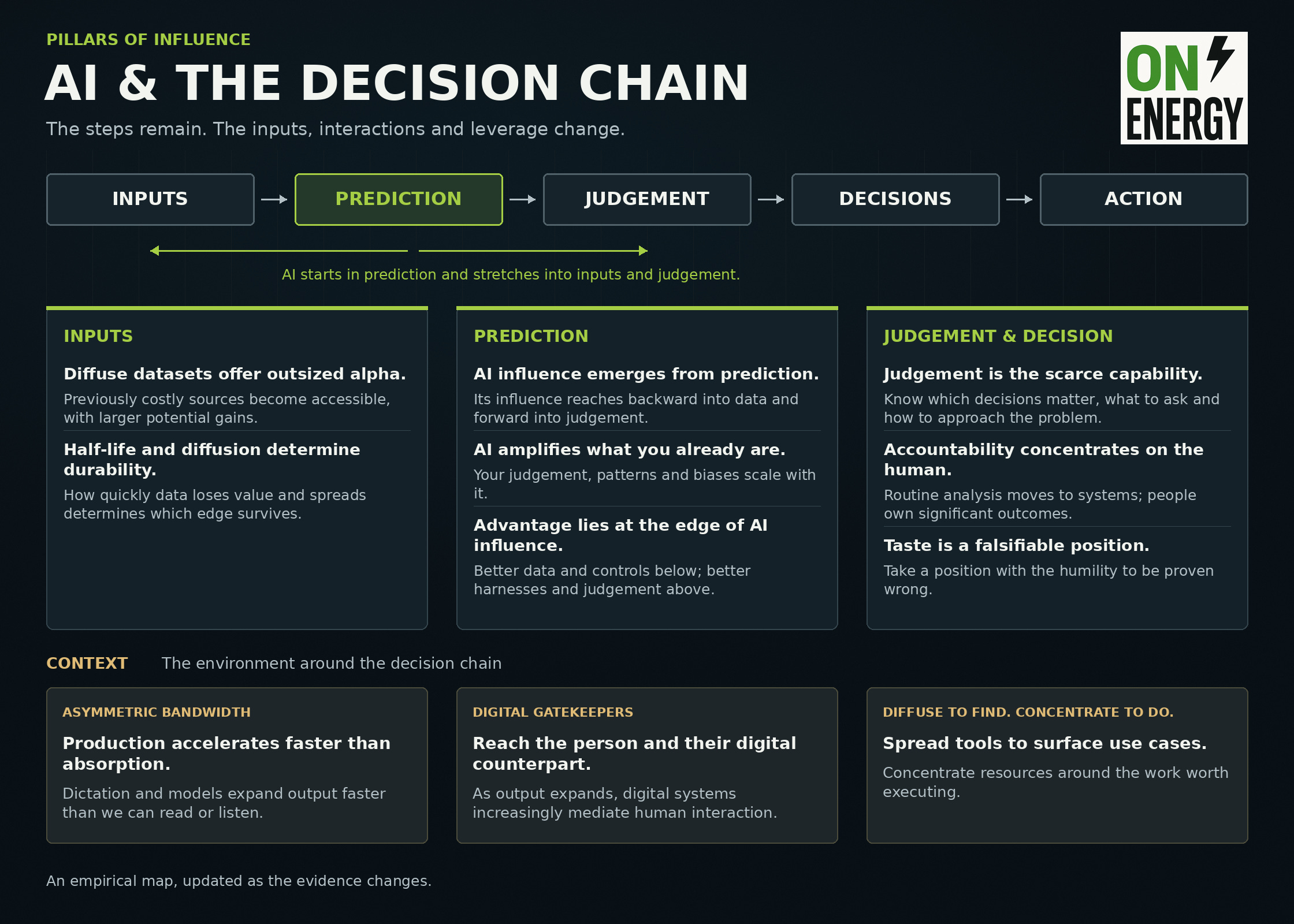
The principal steps in decision making remain the same. We gather INPUTS, we make PREDICTIONS using those inputs, we apply JUDGEMENT to those predictions, and we make DECISIONS and take ACTION based on our judgement. What is changing is what we feed the process, how we engage at each step and with each other, and where the leverage sits in the chain, and how much leverage sits there.
This is an empirical list based on my experience and observations. It will grow or shrink as the evidence dictates.
Pillars of Influence
Inputs
Diffuse datasets offer outsized alpha. Diffuse sources are less exploited because it was previously too expensive or difficult to discover them or concentrate them. However, their impact can be larger in both absolute and relative terms: going from 60% to 70% can be better than from 90% to 95%.
Half-life and diffusion determine durability. Half-life is how fast data loses value. Diffusion is how fast it spreads. The combinations of those two decide which edge survives once the chase is cheap.
Prediction
AI influence emerges from the prediction layer. The chain is inputs, prediction, judgment, decisions. AI starts in prediction and stretches backward into what data is available and forward into judgment.
AI amplifies what you already are. It amplifies your judgement, your patterns, and your biases.
Your advantage lies at the edge of AI’s influence. Better data and controls under the model produce better predictions. Better predictions and harnesses enable better judgement.
Judgment and decision
Judgment is the scarce capability. The edge is knowing which decisions matter, what questions can influence them, and how to approach the problem.
Accountability concentrates on the human. Routine analysis moves to the system. Human attention concentrates on decisions of significance where a person must be held to the outcome.
Taste is a falsifiable position. This requires judgement to take a position, and the humility to be proven wrong. Output that cannot be wrong is not taste.
Context
Human input-output bandwidth is expanding asymmetrically. Production is speeding up faster (through dictation and models) than absorption (reading, listening etc.).
Digital gatekeepers stand between people. As digital output expands, digital gatekeepers take on a bigger role mediating and enabling human interactions. Anyone producing for another person has to interface with both the person and the digital counterpart in front of them.
Diffusion to find the work, concentration to execute it. Spread the tools so use cases surface. Concentrate resources around work worth doing.