Velocity Lowers the Bar
A faster loop keeps competitors resetting, and feedback means your first pass only needs to be right enough.

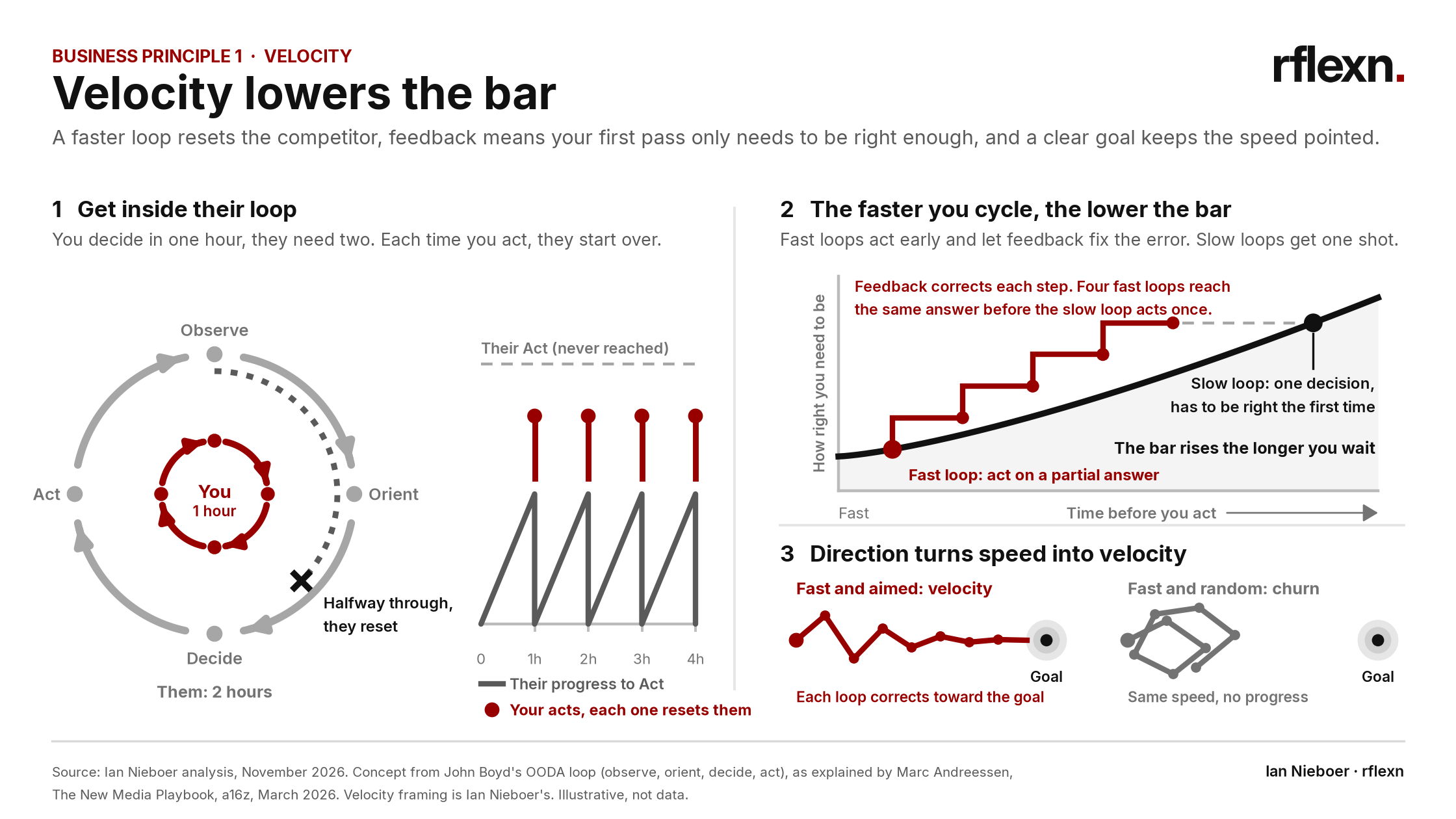
Moving fast toward a clear goal lowers how right you need to be. Your first pass only has to be right enough, because feedback lets you fix it before the mistake costs you anything.
I started this one as speed. Marc Andreessen got me thinking about it on The New Media Playbook, walking Ben Horowitz through John Boyd’s OODA loop. Boyd was a US Air Force fighter pilot and strategist who described every decision as a loop of observe, orient, decide and act. Andreessen sums it up in two words. “Speed wins.” The OODA discussion starts at 26:31, and a16z also cut it into a short clip.
The part that stuck with me is what a faster loop does to the other side. Say you take an hour to decide and your competitor takes two. You act at the one-hour mark, when they are halfway through. You have changed what they were looking at, so they start over. An hour later it happens again. Keep that up and, in Andreessen’s telling, they never get oriented and end up purely reacting. In his words, “If speed is the thing that matters, then the person who gets through that cycle the fastest is the one who’s going to win.”
I have since changed the word to velocity, because velocity includes direction. There is no point being fast in the wrong direction, or in a random one. A team that changes course every week with no fixed goal looks busy and gets nowhere. It resets its own loop as often as anyone else’s.
Feedback is what keeps the direction honest. Each result tells you whether you got closer to the goal. I think that work happens in orient, the step where you decide what the facts mean relative to where you are trying to go. With a clear goal you know which signals matter, so you orient quickly and each fast decision builds on the last one.
That is also why velocity lowers the bar. Being right still matters, but much less on the first pass or the first delivery. If your loop is quick, a first version that is right enough gets corrected by what comes back, and you reach right sooner than you would by waiting. If a decision takes six months, the next chance to fix it is six months away. That decision has to be right going in, and every week it sits in review raises the bar further.
This does not hold everywhere. Some decisions give you no feedback for years and cannot be undone, like a 30-year offtake contract, an investment decision on a plant, or a senior hire. Speed buys very little there, and taking your time is the right call. Andreessen allows for this too. He says you still need enough time to make the decision properly. Most business decisions are reversible and cheap to fix, though, and those are the ones to run fast and point at the goal.
Right enough is doing a lot of work in all of this. It is also where the next principle picks up. Decisions pay when you are right enough, early enough, about things that matter enough.
Credit to John Boyd for the OODA loop, and to Marc Andreessen and Ben Horowitz, The New Media Playbook (a16z, March 2026). The velocity framing is mine.
Discussion about this post