Decision Value Equation
Right enough, early enough, about things that matter enough. The three multiply, so missing any one zeroes the payoff.

A decision pays when you are right enough, early enough, about something that matters enough. Miss any one of those and it pays nothing.
I write it as Decision value = Right x Early x Stakes.
Right is the probability you turn out to be right. Early is how far ahead of everyone else you are when you act, far enough to get positioned before the crowd so you actually benefit when you are right. Stakes is whether the outcome affects you or your business at all. There is no point being right about something that does not.
I multiply them on purpose. If you added the three, a big score on one could cover for a weak one. Multiplied, any factor close to zero drags the whole thing to zero with it.
Once you look for the failure modes you see them everywhere. You can be right and early about something trivial, like calling which session at a conference will be standing room only. Nobody acts on it and nothing changes. You can be right about something big and still be late. If you work out that a market is going to tighten after the price has already moved, you were right and it paid nothing, because the crowd got there first. And you can be early on something big and simply wrong. That one costs the most, because you acted on it.
Energy has plenty of the late kind. By the time a theme is on every conference agenda, being right about it is mostly priced in. The value sat with whoever saw it a year or two earlier, when it still looked like a stretch.
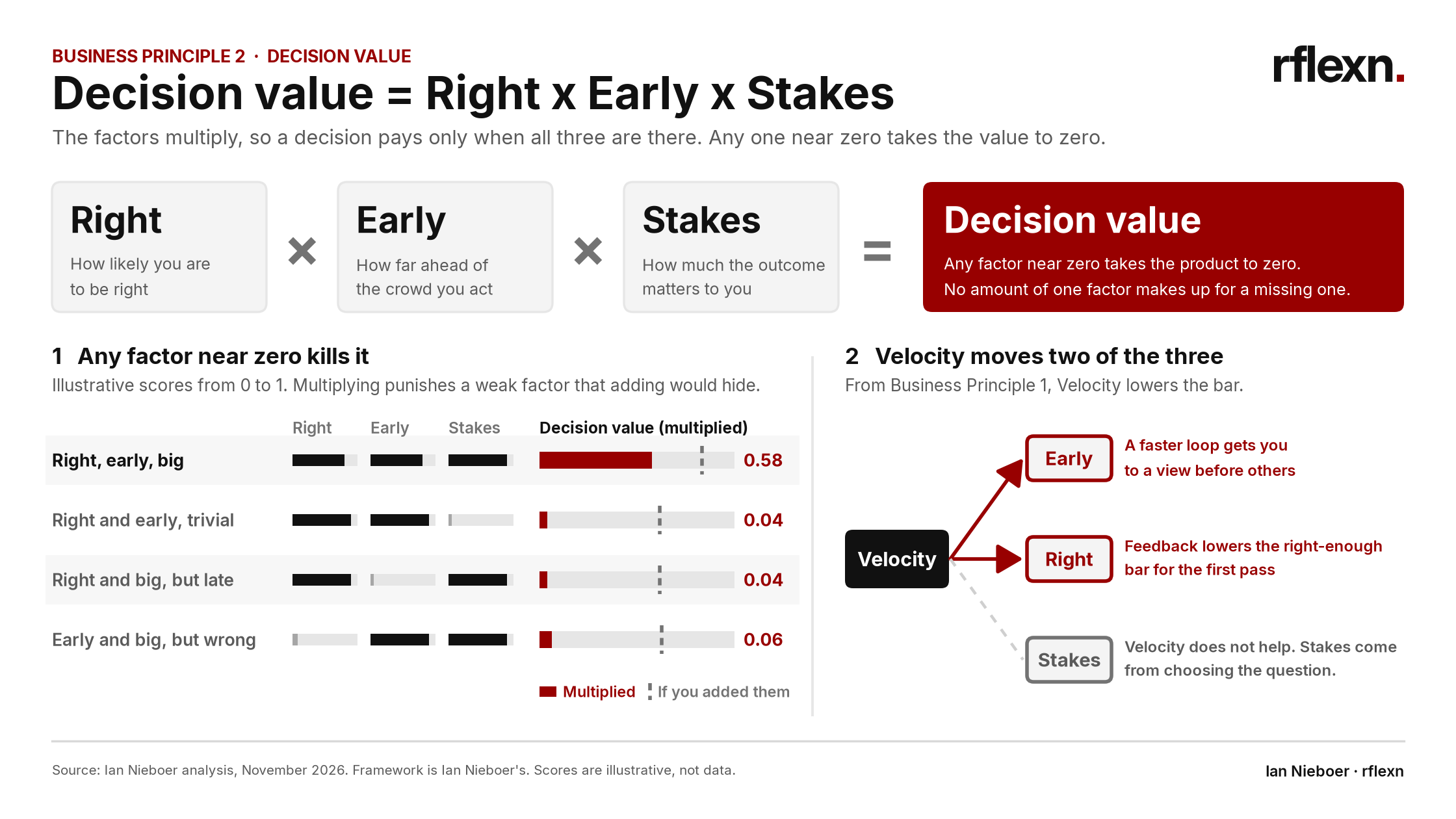
This is also why velocity came first on my list. A faster loop gets you to a view before other people, which is early. It also lowers the right-enough bar, because feedback lets you correct a first pass that was only partly right. Speed with a direction moves two of the three factors at once.
Stakes is the one velocity does not touch. That comes down to which questions you choose to spend time on in the first place, and I think it is the factor people skip most. Being right feels good whether or not it matters, so a lot of careful, early analysis goes into questions nobody needed answered.
If this looks like expected value, probability times payoff, that is because it is close. I pull timing out as its own term because the payoff for being right shrinks as other people catch up, and I think that decay usually decides whether a good call made any money.
Before I put real time into a question now, I want a rough answer on each of the three. If any of them comes back close to zero, I move on to something else.
Discussion about this post