


The resurgence of interest in nuclear has been one of the big stories of 2025. Nearly every week brings a new headlines about a new power purchase agreement, advances in reactor technology or government support to accelerate development. And in many cases, big tech is the protagonist, with their interest in the technology surging alongside their AI driven demand for power.
Question: Nuclear is back. But does it have staying power?
Reading the bullish signals and Big Tech adoption one might believe a boom in new nuclear capacity construction is just around the corner. But is it? That question, and distinguishing between opportunistic capture of existing capacity and a viable path for future deployment was the focus of the week.
Analysis: The Nuance Behind the Nuclear Renaissance
Three structural forces challenge the long-term thesis: the flexibility mismatch, the velocity of learning curves, and whether the tech led boom is strictly a US phenomenon. Read the full analysis in “The Nuance Behind the Nuclear Renaissance”

Idea: The Nuclear Cost Curve
Costs curves are a major hurdle for new projects. Western markets exhibiting negative learning curves (rising costs) while Asian markets show the opposite. Is this intrinsic (the Western “Curse”) or a function of regional factors (the Asian “Counter-Proof”)? One explanation for this observational paradox is that “Forgetting Rates” (atrophy) can outpace “Learning Rates” when the construction cadence drops below a critical threshold. Read the full analysis in “Nuclear Cost Curve”.

Conversation: We explore the current conflicting narratives surrounding nuclear energy, contrasting the excitement from big tech companies investing in Small Modular Reactors (SMRs) with a recent, more pessimistic World Nuclear Industry Status Report. Watch the replay of The Nuclear Paradox.

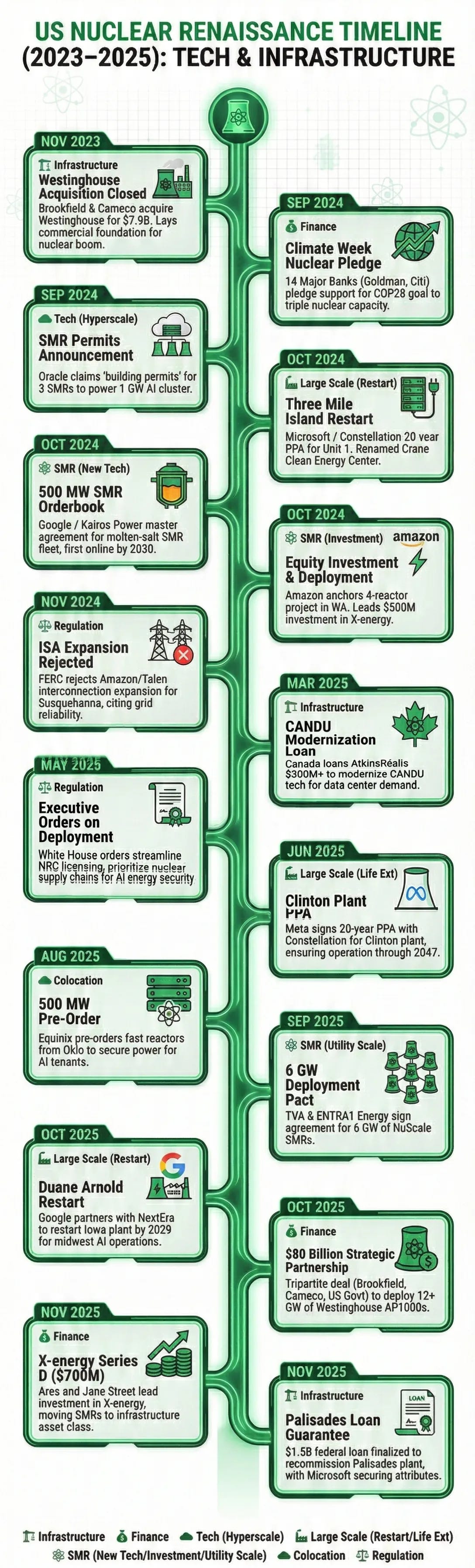
Visual: One image to save.
The cascade of headlines and announcements fueling the nuclear renaissance.
The forgetting rate concept is fascinating, especially when you consider that Western markets basically stopped building reactors for decades while Asia kept a steady pipeline. It really makes you wonder if the cost escalation we're seeing is less about the technology itself and more about losing the institutional muscle memory. If Big Tech really wants to make this work, they might need to commit to more than just a few flagship projects to get that learning curve moving in the right direction again.