Advantage Sits at the Edge of AI’s Influence
Everyone has the same models. The advantage is in what surrounds them: the data underneath and the harness on top.

Most of us have access to the same models. So where does the advantage come from? I think it sits at the edges of AI’s influence, in what surrounds the model.
The decision chain is inputs, prediction, judgment, decision. AI’s influence emerges from the prediction layer. It starts there and stretches backward into what data is available and forward into judgment. The model is the middle of that chain. The edges are where you can still build something a competitor cannot copy by signing up for the same API.
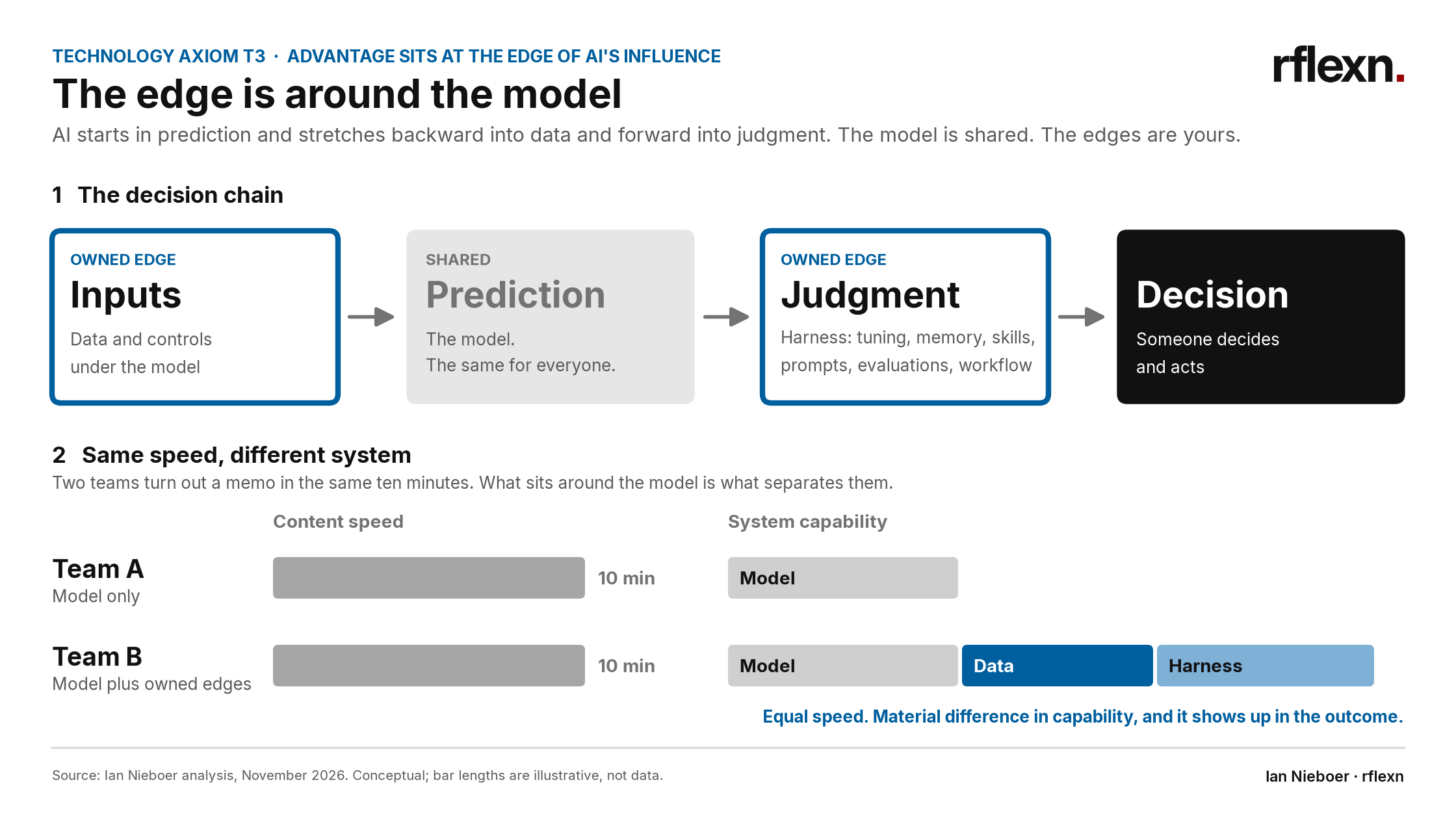
Backward, the edge is the data and the controls under the model. Better data and controls under the model produce better predictions. A near-frontier or open-weight model, paired with the right data and measured against the work that actually matters, can beat a generic frontier model on the jobs that pay you.
Forward, the edge is the harness around the model. Better predictions and harnesses enable better judgment. That harness is the tuning, memory, skills, prompts, evaluations and workflow design you layer in. A large cohort of pre-built agents, tensioned by the experience of the past, lets you go further and do better than coding every gap on the fly. That expertise becomes an asset you either own or rent.
This is why two teams can be similarly fast and still be far apart. AI has democratized the speed of content. Two analysts can turn out a memo in the same ten minutes. One has a system with proprietary data, tested workflows and evaluations built around the work that matters. The other has a chat window. Same speed, a material difference in capability. That difference shows up in the outcome, and it compounds with every cycle.
It changes where to invest. For most companies, the edge was never only in the model. It is in proprietary data, domain judgment, workflow design and evaluation. The newest model is the one everyone gets at the same time, and it is also the least understood. Building the data and the harness is slower, and it is yours.
Keep using frontier models. Build the advantage around them, and own the parts that would be hard to replace. If a model can be switched off above you, as I wrote in Build for the Off Switch, the data and the harness are what you still have the next morning.
Then put judgment on top. A better system gives you better predictions faster. Someone still has to decide which of them matter.
Discussion about this post