
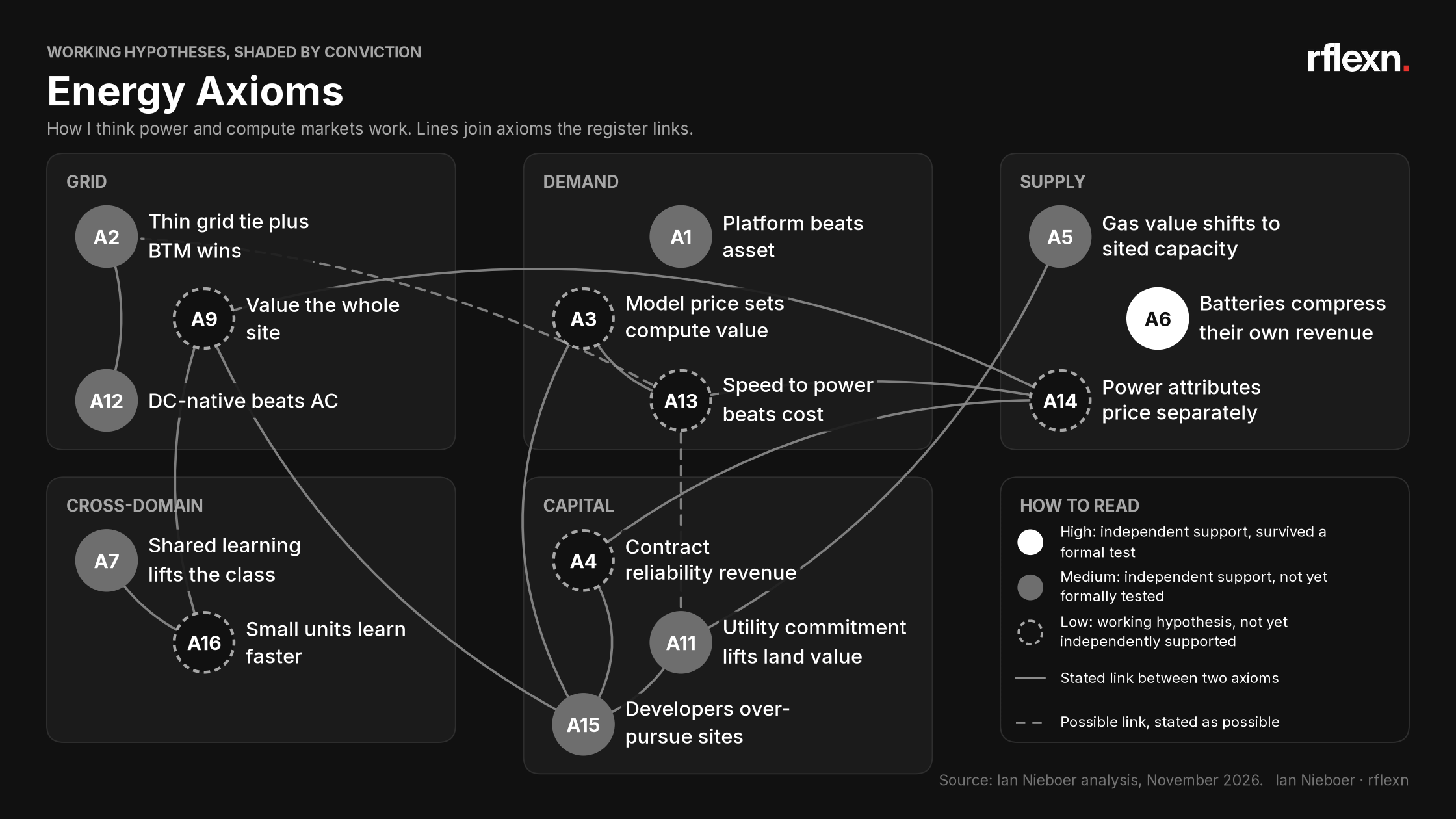
These are the rules I use to reason about power and compute markets. Each one is a working hypothesis: a mechanism I think holds, shaded by how much evidence it has survived so far. I test them against what the market does and redraw the map when the evidence moves.
Demand
A1 ◐ Medium. The unit of competition for tech-sector energy demand is the integrated platform, not the energy asset, because hyperscalers procure a powered shell in which power is critical but a minority component. Read: Master Builders
A3 ○ Low. The value of data centre compute is set by the price of the model served rather than by the cost of the compute, so power infrastructure returns are exposed to model commoditisation rather than to electricity cost.
A13 ○ Low. Speed to power, not cost, is the variable being optimised in the compute buildout, so participants systematically accept worse unit economics to compress schedule. Read: Time Is the Competition
Grid
A2 ◐ Medium. Hybrid architectures combining a thin grid connection with high-utilisation behind-the-meter resource are cheaper than either fully grid-connected or fully islanded configurations, because the thin connection raises behind-the-meter capacity factor without paying for full nameplate interconnection. Read: Cutting the Cord
A9 ○ Low. The site configuration, not the generating unit, is the correct unit of economic analysis, because unit cost does not price the redundancy, schedule and utilisation effects that determine project returns.
A12 ◐ Medium. DC-native distribution architecture is cheaper than AC on both capital and lifetime energy, so the AC grid interface becomes a cost to minimise rather than a constraint to design around. The claim applies to high-density AI compute facilities and their behind-the-meter generation, not to conventional data centres or facilities whose primary power is grid-supplied AC.
Supply
A5 ◐ Medium. Gas-to-power load adds capital intensity disproportionate to its volumetric gas demand, so gas infrastructure value shifts from molecule throughput to sited capacity. Read: The Paradox of Record Gas Demand
A6 ● High. Battery storage revenue pools compress as a direct function of battery deployment, because the ancillary and arbitrage opportunities that justify entry are consumed by the entrants themselves. The claim applies to merchant storage in organised markets where ancillary procurement stays broadly flat as more storage is added, not to contracted storage or to markets where capacity payments carry the revenue. Read: ERCOT's Battery Brawl
A14 ○ Low. Suppliers can price discriminate across large power buyers, because energy, reliability and environmental attributes are separable and each buyer values them differently. Read: First Nuclear, Now Hydro
Capital
A4 ○ Low. Assets whose primary product is reliability should secure contracted revenue rather than merchant capacity exposure, because system operators are likely to over-procure against overstated load growth forecasts. The claim applies to dispatchable assets whose primary revenue is a capacity or reliability payment, not to low-cost baseload that earns energy rather than capacity revenue. Read: What I'm Watching: Power & Energy Transition Q4 2026
A11 ◐ Medium. Securing a credible utility capacity commitment can produce a disproportionate increase in powered-land value, because it reduces uncertainty over whether the site can serve its intended load. Read: The Goal
A15 ◐ Medium. Developers rationally pursue more prospective site capacity than they ultimately need, because uncertain project completion requires a portfolio large enough for surviving projects to meet demand. Read: The Goal
Cross-domain
A7 ◐ Medium. A technology class advances collectively rather than concentrating, in proportion to the share of its learning that is fungible across instances rather than specific to them. Read: Nuclear Cost Curse
A16 ○ Low. Technologies with small, repeatable development units can improve faster because they enable more useful trials per unit of capital and time. Read: The Nuance Behind the Nuclear Renaissance
I update this map as each axiom is tested. Entries firm up, weaken or drop out as the evidence comes in.
Discussion about this post